
Homepage - Visite/Visit - Mon CV/My CV - Mes travaux/Research - 2irating
(suite des études / Next page)
Voir / see SSRN and Bernard Paranque on ResearchGate or ici pour/for des articles en lignes / papers on line.
***********
Une archéologie d'un mémoire inachevé: Le Savoir et les Mots, à propos des Mots et des Choses et de l'Archéologie du Savoir de Michel Foucault. Mémoire de maîtrise avec mon ami Dominique Martin, Lyon 2, 1979-1980, sous la direction de Pierre Dockès.
************
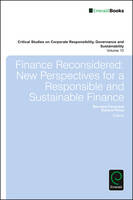
Finance Reconsidered New Perspectives for a Responsible and Sustainable Finance.
Critical Studies on Corporate Responsibility, Governance and Sustainability v.10.
Synopsis
As a response to ongoing economic, social and environmental crises, many private actors have enlarged their definition of 'value' to include environmental and social elements. Such practices, however, appear incompatible with the current epistemological structure of academic financial discourse. This paradox challenges us to reconsider the foundations of modern finance, particularly the dominant role of shareholders. The volume argues there is a need to turn the established order upside down. Studies in economics and finance have to be embedded in environmental and social welfare to answer the challenges we face, and there is a need for a radical break with the methodological individualism that dominates economics, management and (especially) finance. It is our responsibility to question social welfare when it is defined only as maximising shareholder value. Should we instead promote a substitute to the shareholder? How should we (re)define the concept of value? This volume serves as a stepping stone for rethinking academic finance, and attempts to carve out innovative paths for financial research in the 21st century.
La Finance Autrement ? Réflexions critiques et perspectives sur la finance moderne
La finance autrement ? Réflexions critiques et perspectives sur la finance moderne
Depuis 2007, la crise financière a bien évolué et a donné lieu à un nombre considérable d'analyses et de commentaires. Beaucoup de pays ont vu leur économie redémarrer, avec des hausses parfois spectaculaires des marchés financiers. On sait toutefois que le marasme économique se poursuit, notamment en Europe du Sud et de l’Est, malgré des politiques monétaires incitatives ; maints comportements étant restés les mêmes, le monde n’est pas à l’abri d’une nouvelle crise financière encore plus violente que la précédente. Il est donc central de s’intéresser aux politiques d’investissement, c’est-à-dire du financement des anticipations d’activités, tant du point de vue des entreprises et firmes, que des financeurs eux-mêmes à travers leurs stratégies de gestion de portefeuilles. Dans ce contexte, nous proposons une réflexion critique du paradigme soutenant le modèle théorique de la finance moderne. L’Investissement Socialement Responsable (ISR) n’est pas seulement l’expression de la politique de gestion d’un portefeuille mais bien la déclinaison opérationnelle de la politique de Responsabilité Sociale de l’Entreprise (RSE) qualifiant sa politique d’investissement non financière, reflet de la conception qu’elle a de sa responsabilité citoyenne, sociale.
Édité par Bernard Paranque, Roland Pérez. Avec les contributions de Belaïd Abrika, Abdel-Maoula Chaar, Elias Erragragui, Christophe Faugère, Thomas Lagoarde-Segot, Jacques Ninet, Bernard Paranque, Roland Pérez, Cécile Perret, Christophe Revelli, Jean-Michel Servet
Éditeur Presses Universitaires du Septentrion SCIENCES HUMAINES ET SOCIALES, LETTRES . Nb de pages 330 p. ISBN-102757411241
ISBN-13 978-2-7574-1124-7 GTIN13 (EAN13) 9782757411247
******
Construire l'Euro-Méditerranée
de Bernard Paranque
L'Harmattan 2008
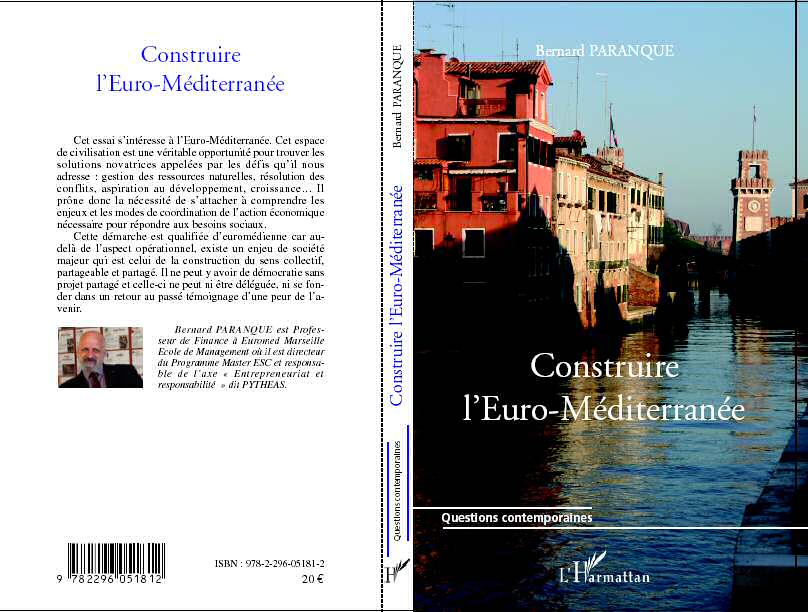
Cet essai s'intéresse à l'Euro-Méditerranée. Cet espace de civilisation est une véritable opportunité pour trouver les solutions novatrices appelées par les défis qu'il nous adresse : gestion des ressources naturelles, résolution des conflits, aspiration au développement, croissance. Il prône donc la nécessité de s'attacher à comprendre les enjeux et les modes de coordination de l'action économique nécessaire pour répondre aux besoins sociaux. Cette démarche est qualifiée d'euromédienne car audelà de l'aspect opérationnel, existe un enjeu de société majeur qui est celui de la construction du sens collectif, partageable et partagé. Il ne peut y avoir de démocratie sans projet partagé et celle-ci ne peut ni être déléguée, ni se fonder dans un retour au passé témoignage d'une peur de l'avenir (L'Harmattan, avril 2008).
« L'euro-méditerranée : de l'espace géographique aux modes de coordination socio-économiques »
sous la direction de B. Paranque, C. Grenier, N. Levratto
L'Harmattan 2007
Cet ouvrage entend revisiter l'espace euro-méditerranéen à travers une analyse pluridisciplinaire qui invite à le penser moins comme un espace géographique, que comme un espace de sens. Ce choix méthodologique est le dénominateur commun des différentes contributions qui proposent une nouvelle conception de l'action économique incorporant la dimension sociale. Sont ainsi proposés à la discussion des éléments de réflexion sur la possibilité de penser différemment des modèles entrepreneuriaux. La démarche est conduite en deux temps. La première partie reconstruit la notion d'espace euro-méditerranéen à la lumière de certaines données de la pensée contemporaine et en incorporant notamment la dimension métaphorique. En découle l'identification d'espaces de réflexion comme autant « d'installations » capables d'accueillir les problématiques et les enjeux d'une spécificité euro-méditerranéenne. La seconde partie propose une illustration de ce cadre d'analyse à partir d'objets économiques dominés par les questions de coordination. Relations économiques internationales à travers les programmes de développement, rapports inter-entreprises modelés par les réseaux, fonctionnement interne de l'entreprise et modèle entrepreneurial y sont analysés à l'aune des éléments clefs de l'Euro-Méditerranée.
« Comprendre les économies d'outre mer », sous la direction de N. Levratto, chapitre 9 avec N. Levratto et L Tessier «Analyse de la performance économique des entreprises domiennes et métropolitaines », L'Harmattan 2007.
«L'action publique et ses dispositifs» sous la direction de Elisabeth Chatel, Thierry Kirat et Robert Salais, chapitre 2 avec Nadine Levratto : « La puissance publique promoteur de nouveaux critères de décision de financement des entreprises », L'Harmattan 2005.
L'entrepreuriat en euro-méditerranée: entre communautarisme et nouvelle modernité? avec Nadine Levratto et Dominique Leroux
Goodwill des groupes français 1992 - 2002
La nécessité de l'accord, à propos de la Maximisation de la valeur et des parties prenantes, un texte de M. Jensen voir aussi La Nécessité d’une Alternative à la Création de Valeur Actionnariale?
Un essai sur les PME - avis et commentaires sont les bienvenus - ( version longue)
Séminaire de l'IDHE - Institutions et Dynamiques Historiques de l'Economie - Ecole Normale Supérieure de Cachan 21 octobre 2002
Conférence des Nations Unies sur le Commerce et le Développement - Réunion d'experts sur l'amélioration de la compétitivité des PME: Financement de la technologie pour le renforcement des capacités productives - Genève, 28-30 octobre 2002
"Quelle intermédiation informationnelle pour les PME ?"
"Structures of Corporate Finance in Germany and France" en collaboration avec Hans Friderichs de la Deutsche Bundesbank, "Jahrbücher für Nationalökonomie und Statistik", Stuttgart - octobre 2001.
"A propos de la contrainte de valorisation" Colloque Marx International 3 Paris 27, 28 et 29 septembre 2001 - Université Paris X Nanterre
Download . La question centrale est celle de l'évaluation et de la satisfaction des besoins de la firme au regard de la cohérence de sa logique et la confrontation avec celle de l'apporteur de capitaux. De ce point de vue, on peut opposer en première approximation, les entreprises selon les modes d'accès aux sources de financement, en particulier de marché. Une grande entreprise est une société dont la logique et celle de l'investisseur externe sont proches de part la confrontation permanente à l'offre et la demande de titres; une PME sera celle dont la logique relève plus de l'accumulation, validée par la confrontation avec le marché des biens et des services. En reprenant une terminologie marxienne, les premières devraient gérer comme contradiction première une contrainte d'accumulation sous contrainte de valorisation, les secondes une contrainte d'accumulation sous contrainte de réalisation. Autrement dit et pour faire simple au risque d'être simpliste, dans un cas le procès de circulation prime, dans l'autre c'est le procès de production.
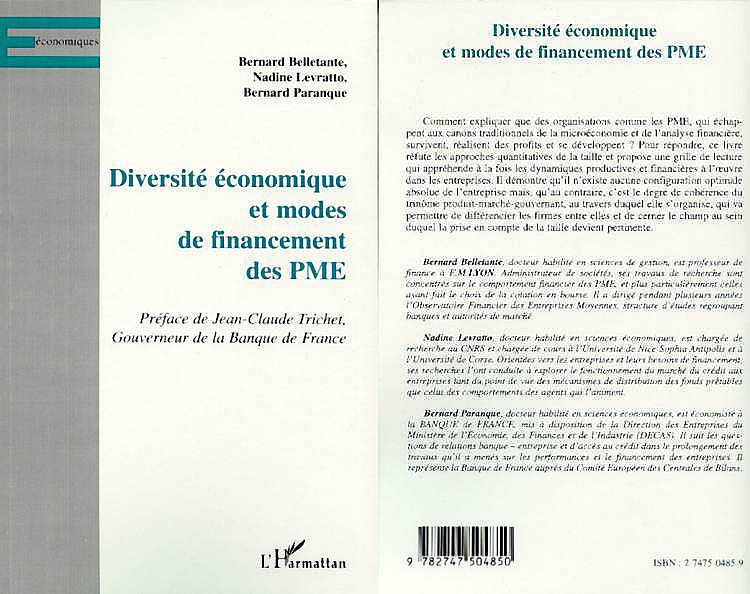
"Diversité économique et modes de financement des PME"
préface de Jean-Claude Trichet, Gouverneur de la Banque de France en collaboration avec Nadine Levratto (CNRS) et Bernard Belletante (Euromed Marseille Ecole de Management) chez L'Harmatan collection " Economiques ". Achat en ligne, format électronique "e-book" disponible sur L'Harmattan.
Présentation de l'ouvrage dans la revue Humanisme et Entreprise - numéro 249 octobre 2001 (article1001.pdf).
"Corporate Finance in Europe from 1985 to 1996"
European Committe of Central Blance Sheet Data Offices
en collaboration avec Michel Delbreil, Banque de France; Franco Varetto, Central dei Bilanci;
Franz Partsch, Öesterreichische Nationalbank; Hans Friderich, Deutsch Bundesbank;
Anna Esteban, Banco de España.
Download from Social Sciences Research Network (SSRN).
(statistics available from here ( ceecdb.zip )).
" Besoins de Financement et accès au crédit." Le Monde des Entreprises DEcas, numéro 13, septembre 2000. doctrine-art.pdf
" Flexibilité financière des PME.", in "Le Capital Risque" Techniques financières et développement, 55-56, juin-septembre 1999, éditeur Epargne sans Frontière gratice-eficea.pdf
" Spécificité financières des PMI françaises dans le contexte européen.", in "Innovation, Financement et Capital Risque" Cahiers du Gratice - Université Paris XII Val de Marne , n°16, premier semestre 1999, coordonné par Mondher Cherif.gratice.pdf
"Corporate Finance in Germany and France"
A Join Research Project by the Deutsche Bundesbank and the Banque de France
by Hans Friderichs, Dieter Gerdesmeier, Elizabeth Kremp, Bernard Paranque,
Annie Sauvé, Manfred Scheuer and Elmar Stöss
(télécharger la version française Bulletin de la Banque de France n°70, octobre 1999 dans la zone "les publications" - téléchargement. voir ci-après le résumé en français).
download the english version from Social Sciences Research Network (SSRN)
"Modes de financement des entreprises allemandes et françaises"
Un projet de recherche commun de la Deutsche Bundesbank et de la Banque de France
par Hans Friderichs, Dieter Gerdesmeier, Elizabeth Kremp, Bernard Paranque,
Annie Sauvé, Manfred Scheuer et Elmar Stöss
( une synthèse bulletinbdf.pdf)
"Structure financière des entreprises industrielles françaises: une approche en terme d'économie des conventions".
en collaboration avec Dorothée Rivaud-Danset (Université de Reims Champagne-Ardenne et chercheur associée au CEPN-CNRS (Paris 13).
Bulletin de la Banque de France, septembre 1998 numéro 57.
Cliquez ici pour télécharger la conférence sur « les PMI ont-elles encore besoin des Banques ? »
Banque de France Rouen le 26 février 1998.
FINANCE AND SMALL MANUFACTURING FIRMS: DO MARKET LISTING AND SIZE ENTAIL BEHAVIOURAL DIFFERENCES?
en collaboration avec Bernard BELLETANTE
43rd ANNUAL ICSB WORLD CONFERENCE JUNE 1998 - SINGAPORE.
Down load from SSRN December 26,1998 or version française à partir du bulletin mensuel de mai 1998 numéro 53 de la Banque de France
FRENCH MANUFACTURING
FIRMS AND THE CAPITAL GAP SINCE 1985 : A CREDIT RATIONING APPROACH
SSRN-FEN
Ref:JFA:A-WPS98-111 or here in english or voir aussi le Bulletin de la Banque de France, 1er trimestre 1997.
en collaboration avec Sylvie CIEPLY, UNIVERSITÉ LYON 2, CENTRE DE RECHERCHE MONNAIE FINANCE BANQUE
Net Equity and Corporate Financing in Europe:
A Comparative Analysis of German, Austrian, Spanish, French and Italian Manufacturing Companies With Share Capital During The Period 1991-1993
with Michel Delbreil, Banque de France; Franco Varetto, Central dei Bilanci; Franz Partsch, Banque Centrale d'Autriche; Hans Friderich, Deutsch Bundesbank; José Ramon Cano, Banque Centrale Espagnole et Benoît Gress, DG2.
SSRN Journal : August 10, 1998
Pour un résumé en français numéro de mai 1997
CORPORATE
BEHAVIOUR AND COMPETITIVE FORCES
corporat.pdf The purpose of this article is to propose a typology of the economic
behaviour of French industrial companies in 1993 based on a sample of more
than 7,000 companies participating in the Balance Sheet Data Centre of
the Banque de France. The objective is therefore to explain how productivity
and competitiveness shape a company's rate of return. Three performance
levels have been put forward: the "physical" level, the "market"
level and the "financial" level, corresponding respectively to
labour and capital productivity, the profit margin and the return on assets.
The relationship between various types of behaviour and the competitive
forces ( M. Porter, 1986 ) affecting these companies is then examined on
the basis of a sub-set of companies that participated in the Sesame survey
and are included in the qualitative data base maintained by the Companies
Division at the Banque de France.
GROWTH PATTERNS AND ECONOMIC PERFORMANCE
OF FRENCH MANUFACTURING FIRMS
growthpa.pdf
COMPÉTITIVITE ET RENTABILITÉ DES ENTREPRISES INDUSTRIELLES FRANÇAISE ( 1990 - 1993 ).
EQUITY AND RATE OF RETURN: ARE SMALL MANUFACTURING FIRMS HANDICAPPED BY THEIR OWN SUCCESS?
Pour accéder au site de la Banque de France cliquez-ici / click here.